In our second annual report, we reveal which retail and restaurant brands customers say are resonating with them most through the physical experience.

Ask most companies what their brand is, and they’ll point to a logo, a campaign, maybe a tidy messaging framework. Those things are real, and they matter. But they’re the expression of a brand, not the brand itself. They’re what the asset looks like. They aren’t the asset.
Here’s a more useful way to think about it: Brand is accumulated belief. It is built through repeated proof over time, until customers stop questioning what a company stands for and start expecting it. Customers draw on that belief every time they choose you without shopping around. Businesses draw on it every time they command a premium, enter a new category, weather a mistake, or withstand competitive pressure.
Once you see brand this way, the tired old question of “how do we align brand and experience?” falls away. Brand, customer experience, and operations aren’t three departments learning to get along. They’re three views of one system. The only question worth asking is whether that system is strengthening customer belief or eroding it.
Out of all the brand touchpoints, the physical environment is the richest. And the reason is almost mechanical.
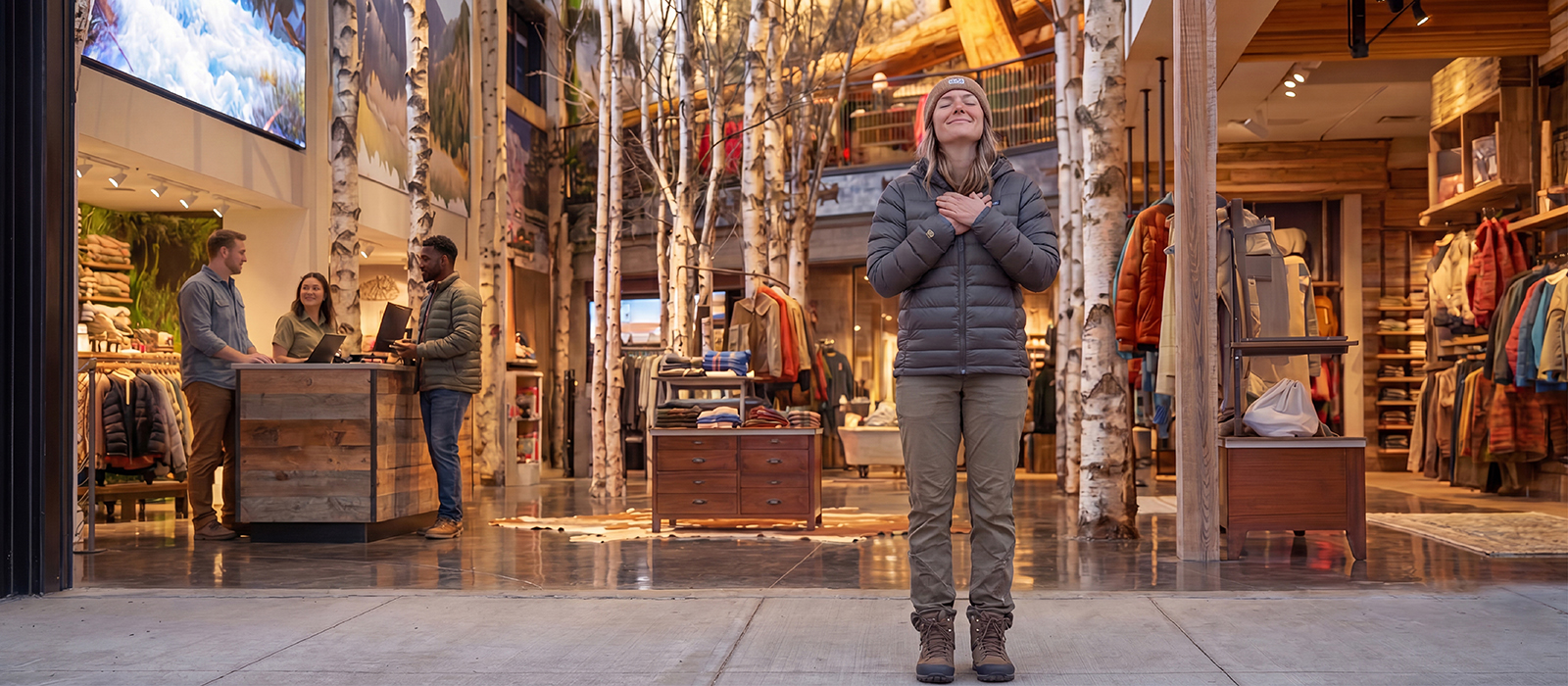
Talk is cheap. You can write “we care about quality” on a homepage for free, and anyone can. A built environment is a different thing entirely. You can’t fake a store. Every surface, fixture, and material, every merchandising choice, every staffing decision, every small ritual at the register is proof that took real money and real intent to put there. Customers feel that before they can explain it. They walk in and the place either feels right or it doesn’t, and that read happens long before anyone weighs your actual claims. If the room doesn’t add up, they never get to the part where they evaluate your pitch. Belief comes from what the experience proves, not from what the brand says about itself.
Some brands have to do this fast. A packaged-goods brand gets years to settle into a customer’s mind. A car-rental brand gets about ten minutes at the counter. It has to behave, on first contact, like something already worth trusting, doing in one interaction the compounding work a CPG brand gets a decade to accumulate. That’s an extreme version of a pressure every retailer feels.
That pressure is exactly why integration is structural rather than nice-to-have. A brand idea has to show up in every touchpoint. When each element works together, they create belief.
At ChangeUp, we think about this through a simple framework: Feel. Believe. Remember.
Each one is a different way to shape how customers experience, trust, and remember the brand:
Decide what customers should feel, what they should believe, and what they should remember before designing anything. Then ensure each decision supports those outcomes.
At scale, this comes down to three disciplines.
One brand idea, built into the operation. What the brand stands for becomes what each location is actually built to do. Not a set of guidelines taped to the break room wall, but real decisions about flow, staffing, and the signature moments worth getting right.
Treat the fixed stuff as proof. Every permanent element of the environment is evidence of what the brand stands for. Every flexible element is room to adapt to local context. This is how a brand stays consistent everywhere and still feels relevant on a particular corner, without one eating the other.
Earn belief at the speed the category demands. Some brands have minutes. Retailers have thousands of small interactions across locations, channels, and moments. Either way, every touchpoint is a piece of behavior the customer reads, and the journey becomes a run of small proofs that the brand is who it claims to be.
A brand that compounds belief at scale pays off in ways you can put on a slide. It earns pricing power, because customers see more value and argue with the price less. It lowers acquisition cost, because the brand has already half-made the decision before the customer arrives. It buys permission to expand into new categories and formats with less risk on the way in. It holds up when competitors copy the product, the promo, or the layout. And it builds the kind of loyalty that runs on something sturdier than convenience.
That last point matters more every year. Products get commoditized. Distribution keeps getting handed off to platforms that sit between you and the customer. When that happens, customer belief is what endures. It’s the one asset competitors can’t easily copy and aggregators can’t strip out, because it doesn’t live in your supply chain or your app. It lives in the customer’s head, and it gets reinforced every single time they deal with you.
So the real job isn’t building awareness. Plenty of brands are known and still chosen last. The job is building belief, and proving it through every experience, every operational call, and every physical detail. The brands that win won’t treat brand, experience, and operations as separate disciplines handed to separate teams. They’ll run them as one system for creating value: felt in the moment, durable across the relationship, and genuinely hard for anyone else to replicate.
That’s the work. Connecting brand, customer experience, operational design, and the physical environment into a single system, engineered to turn belief into stored value. Visible in the moment. Durable across the relationship. Built to hold up against whatever comes next.